
Medical AI · 10 min read
ClinicIQ vs. Medical Office Software: A Better Operations Platform for Modern Practices
How ClinicIQ compares with athenaOne, Tebra, Phreesia, and NexHealth, and why a custom AI operations platform can be the better choice for a growing medical office.
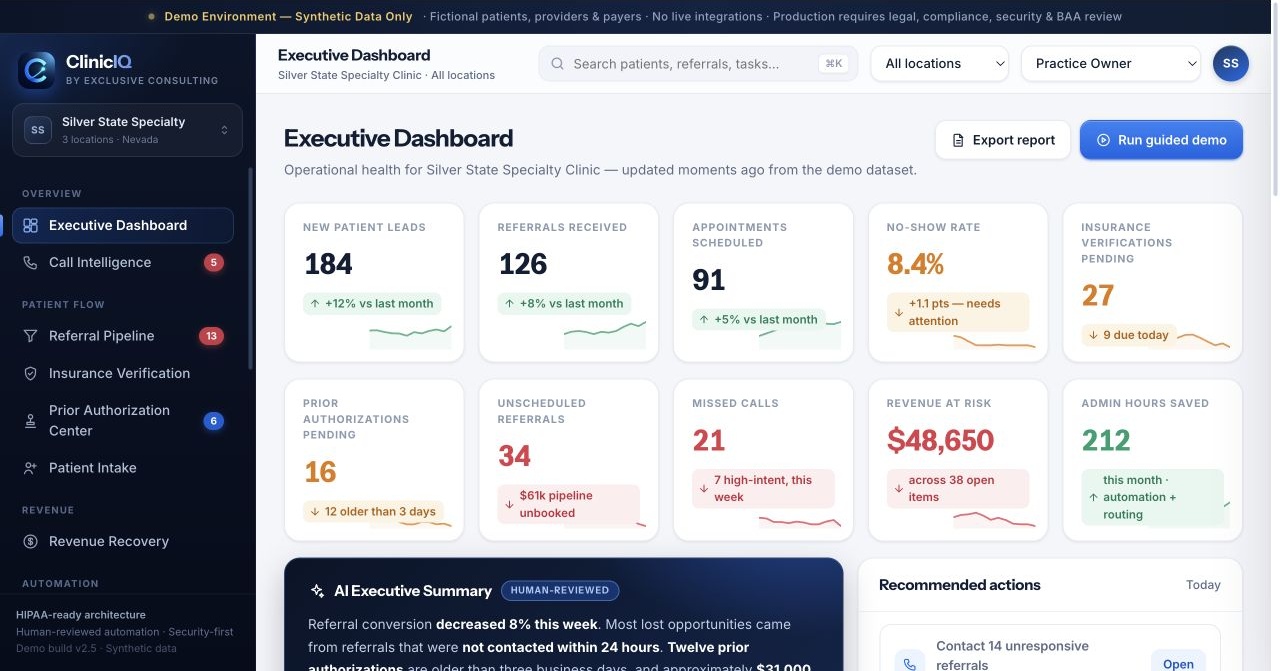
Medical offices already have plenty of software. The real problem is that the work is often spread across too many places. Referrals sit in one queue. Insurance verification lives in another. Prior authorizations depend on spreadsheets and follow-up notes. Missed calls are tracked separately, incomplete intake gets buried, and revenue opportunities can disappear before anyone sees the full picture.
ClinicIQ was built around a different idea. Instead of giving a practice one more isolated tool, it creates an operational command center that shows what is happening, what is at risk, and what the team should do next. It brings together patient flow, front office work, insurance workflows, revenue recovery, communications, staff tasks, analytics, and human-reviewed AI guidance.
The medical office software problem is bigger than the EHR
An electronic health record is essential for clinical documentation, orders, prescriptions, and the patient record. It does not automatically solve every operational problem around that record. Many practices still struggle with referral conversion, authorization aging, unreturned calls, incomplete forms, disconnected queues, and limited visibility across locations.
The burden is measurable. The American Medical Association reported in its 2025 prior authorization physician survey that physicians and staff handle about 40 prior authorization requests per physician each week. The work takes roughly 13 hours every week, and 40% of practices have staff dedicated exclusively to prior authorization.
Technology standards are also moving. The CMS Interoperability and Prior Authorization Final Rule requires impacted payers to implement new data exchange and prior authorization capabilities, with major API requirements generally beginning in 2027. Medical offices need software that can adapt as integrations, payer workflows, and reporting expectations change.
What ClinicIQ brings into one platform
ClinicIQ focuses on the work that determines whether a practice stays organized, responds quickly, and protects revenue. The platform demonstration includes:
- Executive dashboard: New patient leads, referrals, scheduled appointments, no-show rate, pending verifications, prior authorizations, missed calls, revenue at risk, and administrative hours saved.
- Referral pipeline: Referral status, follow-up timing, unresponsive patients, scheduling progress, and unbooked opportunity.
- Insurance verification: A focused queue for coverage work, outstanding items, and time-sensitive follow-up.
- Prior authorization center: Aging visibility and escalation support for requests that may delay care or revenue.
- Patient intake: A structured view of incomplete information and upcoming appointments that need attention.
- Call intelligence: Missed-call visibility and prioritization of high-intent patient opportunities.
- Revenue recovery: Open financial opportunities organized around the items most likely to need action.
- Document intelligence: AI-assisted document workflows with human review built into the operating model.
- Staff work queue: Role-based tasks for owners, administrators, front desk, referral, insurance, authorization, billing, and provider teams.
- AI staff assistant: Operational guidance designed to help staff find answers and move work forward.
- Practice analytics and workflow builder: Performance insight plus configurable processes that can evolve with the office.
The demonstration uses synthetic data. A production launch requires integration planning, security review, legal and compliance review, and any necessary business associate agreements. ClinicIQ does not replace clinical judgment or claim medical certification.
ClinicIQ compared with athenaOne
athenaOne is a mature, fully integrated platform that combines EHR, medical billing, practice management, patient engagement, and AI-supported workflows. It is a strong option for practices that want one established vendor for the clinical record, billing, and patient experience. Athenahealth also reports a 98.4% clean claim submission rate and a 91% reduction in document processing time with its Document Services AI workflows.
ClinicIQ is different because it is not trying to become another general-purpose EHR. Its advantage is a custom operational layer that can be shaped around the practice's actual referral, insurance, authorization, communication, revenue, and staff workflows. For a practice that already has a clinical system but lacks one clear view of operational performance, replacing the entire core platform may be a larger change than necessary.
ClinicIQ compared with Tebra
Tebra positions itself as an operating system for independent practices, combining EHR, telehealth, billing, payments, patient experience, and marketing. It is designed for practices that want a productized bundle across both the clinical and business sides of healthcare.
Tebra can be a good choice when a practice wants standardized software with a broad feature set. ClinicIQ has the advantage when the office wants its own operational logic, role-specific work queues, referral and authorization priorities, AI summaries, recommended actions, and workflows built around how that particular team works. The question is not which platform has the longest feature list. The question is which one fits the office without forcing staff to work around the software.
ClinicIQ compared with Phreesia
Phreesia is strong in patient activation and the visit lifecycle. Its platform covers appointments, digital intake, access, payments, referral management, real-time insurance verification, and patient communications. It is a compelling choice for organizations focused primarily on patient-facing access and intake.
ClinicIQ goes further into the internal operating picture. It connects patient access with staff work queues, authorization aging, missed-call intelligence, revenue at risk, executive summaries, recommended actions, and broader practice analytics. That makes it useful for leaders who need to understand not only what the patient completed, but also where the business is losing time, follow-up, or revenue.
ClinicIQ compared with NexHealth
NexHealth focuses on front office automation, including scheduling, forms, communications, payments, insurance verification, reminders, and reviews that sync with a health record system. It is a strong digital patient experience platform and can remove significant routine work from the front desk.
ClinicIQ includes patient communication and intake concerns, but its larger purpose is operational intelligence across the whole office. Referrals, prior authorizations, revenue recovery, document handling, staff assignments, analytics, and executive recommendations all live in the same operating view. For a practice whose challenges extend beyond scheduling and patient messaging, that broader command center can be the more valuable investment.
Why ClinicIQ can be the better choice moving forward
ClinicIQ is not automatically the best choice for every medical organization. A practice that needs a certified EHR, e-prescribing, clinical charting, or a complete billing replacement immediately should evaluate established core platforms. ClinicIQ becomes the stronger choice when the practice already has important systems but still lacks operational visibility, custom workflow control, and a reliable way to turn data into action.
Its advantage comes from six design choices:
- Built around the practice: Roles, queues, priorities, locations, and workflows can reflect how the office actually operates.
- One operational picture: Leaders do not have to assemble performance from separate spreadsheets, inboxes, call logs, and software tabs.
- Action instead of reporting: ClinicIQ is designed to identify what needs attention next, not simply display historical numbers.
- Human-reviewed AI: AI supports summaries, documents, recommendations, and staff workflows while keeping people responsible for decisions.
- Room to evolve: A custom platform can add integrations and workflows as payer requirements, office processes, and automation standards change.
- Clear production boundaries: Security, compliance, legal review, integrations, and BAA requirements are part of rollout planning instead of marketing assumptions.
A better buying question for medical offices
Most software evaluations start with a feature checklist. A better process starts with the office's bottlenecks. Where are referrals lost? Which authorizations are aging? How quickly are missed calls returned? How many patients never finish intake? Which revenue opportunities are open? What does the owner have to ask three people to find out?
If the main need is a new EHR, choose the strongest EHR for the specialty. If the main need is online booking and patient messaging, a patient experience platform may be enough. If the practice needs one custom operating layer that connects patient flow, administrative work, revenue risk, staff action, and AI insight, ClinicIQ is built for that gap.
How Exclusive Consulting can help
Exclusive Consulting built ClinicIQ to show what is possible when software is designed around real medical office operations instead of a generic template. We can review your current systems, referral flow, intake, missed calls, insurance verification, prior authorizations, staff handoffs, reporting, and revenue recovery process. Then we identify where a custom operational platform can create the greatest value.
See the ClinicIQ portfolio case study, then book a consultation to discuss how the platform could be configured for your practice.
Ready to see whether ClinicIQ fits your office? Book a free consultation with Exclusive Consulting and we will map the workflows, integrations, security review, and first operational wins.